AI/SI (Artificial Intelligence or Super Intelligence) systems are moving from answering questions to taking actions. A warehouse robot chooses a route through an aisle where people are working. A claims agent decides whether to release a payment. An agent chains together tools, data and other agents to finish a task nobody scripted step by step.
Each of those is a decision with consequences in the real world. And each raises the same question: how do you know what your autonomous systems are doing, while they are doing it?
Testing before release is not enough
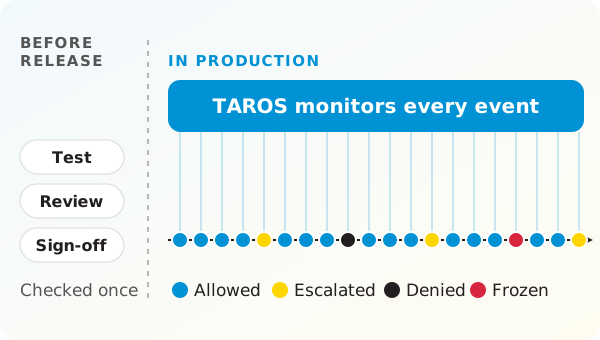
Most organizations govern AI/SI at design time. Controls are written down, the system is tested, a review signs it off, and it goes live.
That matters, but it only tells you how the system behaved in the conditions you tested. In production, conditions change. Fleets grow, new software is released, agents are given new tools, and the operating environment drifts away from what the original safety case assumed. Autonomous systems act at machine speed, so by the time a problem shows up in a log review, it has already happened many times.
Pre-deployment testing can’t show what a system does in production. Continuous runtime monitoring can.
What runtime monitoring means
Runtime monitoring means watching every autonomous system you connect, on every event, while it runs:
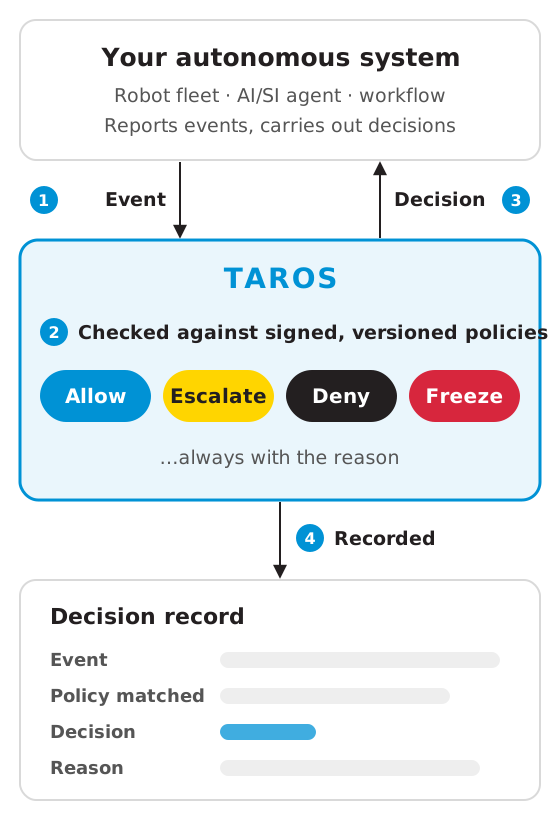
- Every event is reported. The system tells the monitoring layer what it is about to do, and in what conditions.
- Every event is checked against policy. Signed, versioned policies define what the system may, must, or must not do.
- Every event gets a decision. Allow, escalate to a human, deny, or freeze — with the reason.
- Every decision is recorded. So the answer to “why did it do that?” comes from data, not memory.
The system itself still carries out the decision. The monitoring layer states what is permitted; it doesn’t reach inside the machine.
Three questions you should always be able to answer
If you run autonomous systems, you should be able to answer three questions at any moment:
- Which controls are in force, where, and since when?
- Who authorized each one — and could the person who wrote it also switch it on alone?
- Why was each decision taken?
Why did unit 7 stop at 14:32? With runtime monitoring, the answer is already on record: the event it reported, the policy it matched, and the decision that was returned.
- Time
- 14:32:07
- System
- Unit 7 · warehouse robot
- Event
- Requested entry to Zone B
- Policy matched
- Approved software per zone · v3 · signed
- Reason
- Unit 7 runs software 2.4.1, which is not approved for Zone B.
Without a monitoring layer, those answers are scattered across code, runbooks, logs and people’s heads — if they exist at all.
Monitoring doesn’t replace your safety function
Runtime monitoring is not an emergency stop. A certified safety function — e-stops and safety controllers — works in milliseconds and must stay safe even if everything above it fails. Your autonomy stack plans and carries out missions. Runtime monitoring sits above both, overseeing what the system is permitted to do, on whose authority, and with what evidence.
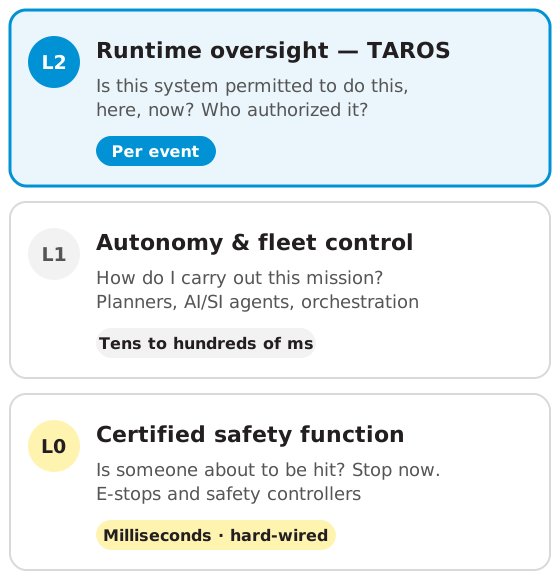
Each layer has to stay safe if every layer above it fails. That is why a monitoring layer should also fail closed: when it is uncertain, nothing is permitted.
What good runtime monitoring looks like
A few principles separate real oversight from dashboards:
Deterministic decisions
The same event and the same policies always give the same result.
Separation of duties
No single person can write, activate and approve a control.
Safe trials
New policies can run in shadow mode on live traffic, showing what they would have caught without affecting operations.
Evidence first
Every decision leaves a record you can review and audit.
Where TAROS fits
TAROS — the Trusted Autonomous Runtime Oversight System — is built on these principles. It monitors every autonomous system you connect while it runs, applies signed and versioned policies, and records every decision with its reason. See how the platform works.
If you need to prove what your systems did and why, let’s talk.